Appearance
Linear Map
Linear map is a special type of homomorphism between vector spaces, which preserves the operations of vector addition and scalar multiplication :
So we can also treat linear map as a kind of transformation (or action) which is performed on vectors in the domain, resulting in vectors in the codomain.
Homomorphism
When talk about homomorphism, a few properties need to be considered, such as:
Null space, which set of vectors in the domain are mapped to the zero by the homomorphism.
Range, which set of vectors in the codomain can be obtained if we send all elements from the domain through the homomorphism.
Injectivity, whether only the zero in the domain is mapped to the zero in the codomain.
Surjectivity, whether every vector in the codomain can be obtained by sending all elements from the domain through the homomorphism.
They reflect the fundamental structure-preserving nature of homomorphisms in linear algebra.
Vector Space of Linear Maps
Collection of linear maps of same type forms a vector space over the same field as the domain and codomain, since it satisfies the addition closure and scalar multiplication closure properties of vector space, which can be expressed as follows:
Why it matters? This allows us to aggregate multiple linear maps (in same vector space) through addition and scalar multiplication, enabling more complex transformations to be constructed from simpler ones. Image that there are thousands of linear maps available; we can combine them in various ways to achieve desired transformations efficiently. This is amazing, is it?
Matrix Representation
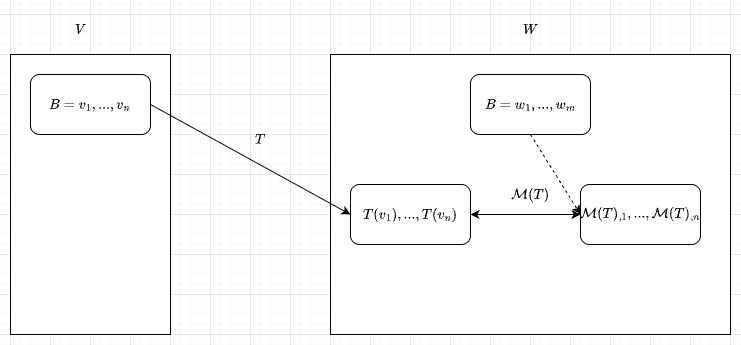
As we know, once the bases of domain and codomain is fixed, then the linear map is only determined by its action on the basis vectors of the domain. That is, where the resulting vectors of the domain basis vectors should go under the linear map uniquely determines the the linear map completely.
Why we need a representation for linear map? Function is an abstract concept, and it can be difficult to work with directly. By representing a linear map as a matrix, we can leverage the well-developed tools and techniques of matrix algebra to perform computations, analyze properties, and understand the behavior of the linear map more concretely.
As we know, linear map is a kind of transformation that performed on vectors in the domain. And a vector space is determined by its basis. So each linear map should be uniquely determined by its action and two vector spaces on both sides :
The basis of the domain vector space.
The basis of the codomain vector space.
The linear map function itself.
Apply action (function) on each basis vector of the domain, resuting in a set of vectors in the codomain. These resulting vectors can then be expressed as linear combinations of the basis vectors of the codomain, forming the columns of the matrix representation of the linear map. So matrix of linear map reflects the coordinates of each basis vectors of the domain in terms of the basis vectors of the codomain.
Bijectivity
Bijectivity is a more strong property than injectivity or surjectivity alone. A linear map is bijective if it is both injective (one-to-one) and surjective (onto), meaning that every vector in the codomain is the image of exactly one vector in the domain. This implies two vector spaces have the exact same structure, it hides the underlying data representation, and allows for the existence of an inverse linear map that can uniquely recover the original vectors from the codomain.
Bijectivity is actually a general concept for function, not linear map. We call it invertibility, if the linear map function is bijective.
Not every linear map is invertible, but once exists an invertible linear map, the two vector spaces are isomorphic, meaning they have the same dimension and structure. The only criteria for invertibility is that the linear map must be both injective and surjective.
The linear map whose domain and codomain are the same vector space must be invertible, and it is a special linear map. We call it linear operator, there are two important special cases:
- If the basis of domain and codomain are also the same, then the linear map is an identity map, just sends each vector to itself.
- If the bases are different, then the linear map is a change of basis map, which transforms vectors from one basis to another within the same vector space.
Product Space and Quotient Space
Product space and quotient space are two derived vector spaces from general vector space.
Product space is just the Cartesian product of spaces, if we sum-up all entry spaces of it, then we get a sum space. So there is must be linear map between product space and sum space. If these entry spaces intersect trivially, then the resulting sum space is a direct sum.
Quotient space is derived from a subspace, it participate a vector space into many subspaces, each subspace is a equivalent class with respect to the subspace. Specially, the individual subspaces also intersect trivially, implying that they can form a direct sum which is isomorphic to the original vector space.
Note that quotient space is an essential step forward to decomposition of vector space.
Duality
Duality on a vector space called dual space, duality on a linear map is called duality dual map. While dual space is the vector space of linear maps mapping a vector to the field underlying the vector space. Dual map is a much more complex linear map, mapping a dual space to another dual space, typically induced by the original linear map between the corresponding vector spaces.
Eigenvalues and Eigenvectors
Eigenvalues and eigenvectors are fundamental concepts in linear algebra that describe the behavior of linear operators on vector spaces.
Eigenvalues are scalars associated with a linear operator on a vector space that indicate how the operator stretches or compresses vectors along certain directions. More formally, if
is a linear operator on a vector space , a scalar is an eigenvalue of if there exists a non-zero vector such that The vector
is called an eigenvector corresponding to the eigenvalue . Not every linear operator has an eigenvalue in the given field, especially if the field is not algebraically closed.
The minimal polynomial of a linear operator
on a vector space is the monic polynomial of least degree such that The minimal polynomial provides important information about the structure of the linear operator, including its eigenvalues and the sizes of its Jordan blocks.
The upper-triangular matrices of linear operators provide a convenient representation that reveals the eigenvalues on the diagonal and simplifies the analysis of the operator's action on the vector space.
But not every linear operator can be represented by an upper-triangular matrix over the given field, especially if some eigenvalues lie outside the field (field is not algebraically closed).
The criterion for a linear operator to be representable by an upper-triangular matrix over the given field is that the minimal polynomial of the operator splits completely over the field, meaning it can be factored into linear factors with coefficients in the field.
That means if the field is
, then there must exists a upper-triangular matrix for every linear operator on a finite-dimensional vector space over . This also shows that at least one eigenvalue exists for every linear operator on such a vector space.